Financial knowledge is also affected by the gender gap

06/03/2026
A clear pattern can be observed across many countries: on average, women tend to score lower than men on standard measures of financial literacy. And Spain is no exception. According to the Survey of Financial CompetencesAbre en ventana nueva, a smaller proportion of women understand concepts such as inflation, compound interest and risk diversification.
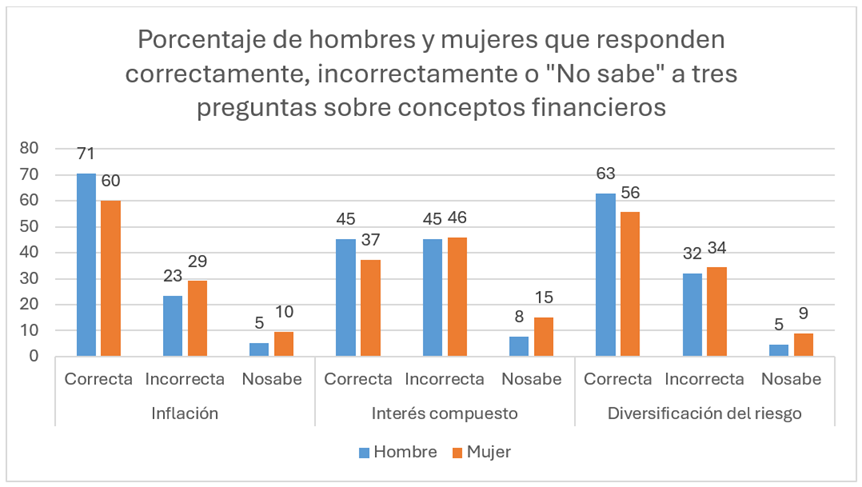
Source: Survey of Financial Competences (2021).
However, the gap is not consistent across groups. It is narrower among young people and widens significantly among the over 65s. And the PISA financial literacy assessmentsAbre en ventana nueva do not show a clear pattern. In 2018 and 2022 no differences were found between boys and girls. In 2015 girls performed better, while in 2012 boys scored higher. This suggests that the gap cannot be explained by a single factor and is influenced by a combination of individual, social and cultural factors.
Why does this gap persist among adults?
A confidence shortfall
Research suggests that a significant part of the gap can be explained by women’s lower confidence in their own knowledge. In multiple-choice surveys, women are more likely to select the response “I don’t know”. When this option is removed or respondents are encouraged to avoid it, the gap narrows considerably. This suggests that women may be less confident in their answers, rather than necessarily reflecting an actual lack of knowledge.
The legacy of legal and economic exclusion
In Spain, as in many other countries, women gained the right to open a bank accountAbre en ventana nueva, take out a mortgage and access credit without the permission of a guardian only a few decades ago. This later entry into the formal financial system may have limited both women’s opportunities to make financial decisions and the transmission of financial knowledge from one generation to the next.
Although these legal barriers have disappeared, the effects of traditional gender roles and cultural biases can still be seen today. Women experience more frequent interruptions to their careers due to childcare and other family responsibilities, earn lower incomes on average, remain underrepresented in science, technology and business-related fields, and even face higher borrowing costs than men even when they have similar financial profiles.
What can we do to reduce the gap?
Promoting inclusive financial education
Some studies identify gender differences even during childhood and adolescence, long before young people start making important financial decisions. This highlights the importance of promoting inclusive financial education from an early age, strengthening girls’ confidence in their abilities and providing role models that challenge traditional stereotypes in areas such as economics, business and finance.
Challenging stereotypes and eliminating discrimination
Closing the gap also requires addressing the social and cultural norms that have historically limited women's financial autonomy. Promoting equality means tackling both conscious and unconscious biases that still exist in homes, schools, workplaces and even within financial institutions themselves.
If you would like to learn more about this topic, take a look at this Banco de España blog postAbre en ventana nueva.